Friday, 22 November 2019

The Important Role of Praxis in Effecting Positive Societal Change

Praxis (Action/Reflection)

Praxis is a Greek word which means, doing action. In critical legal studies, praxis means practical action. It is the practical application or exercise of a branch of learning. It also means the practice of living the ethical life in conjunction and in cooperation with others.


It is not enough for people to come together in dialogue in order to gain knowledge of their social reality. They must act together upon their environment in order critically to reflect upon their reality and so transform it through further action and critical reflection.

Key Components:

Dialogue

To enter into dialogue presupposes equality amongst participants. Each must trust the others; there must be mutual respect and love (care and commitment). Each one must question what he or she knows and realize that through dialogue existing thoughts will change and new knowledge will be created.

Conscientization

The process of developing a critical awareness of one’s social reality through reflection and action. Action is fundamental because it is the process of changing the reality. Paulo Freire says that we all acquire social myths which have a dominant tendency, and so learning is a critical process which depends upon uncovering real problems and actual needs.

The Minessence Values Framework

The Minessence Values Framework [MVF] is an Expert System designed to facilitate this process - see: https://www.mvf-knowledge-base.com/p/mvf.html

Monday, 30 September 2019

The Carbon Cycle & Human Induced Global Warming


For all of human history prior to the industrial revolution the carbon dioxide levels in the atmosphere remained fairly constant due to the natural carbon cycle depicted on the left to the diagram above. 
     Beginning at the industrial evolution, humans added to the carbon cycle. Coal and oil, which trapped carbon millions of years ago, began to be mined for fuel. This human addition to the carbon cycle is depicted at the right of the above diagram. Thus humans through the natural carbon cycle completely out of wack—it was no longer in balance and more carbon dioxide was been added to the atmosphere than was being removed. This imbalance as esabertated through land clearing as, humans were reducing he number of trees on the planet—removing the natural part of the carbon cycle which removed the carbon from the atmosphere.
     In summary then:

    • Humans, via using coal and oil as fuels began adding carbon dioxide to the atmosphere at unnatural levels.
    • Humans, via removing tree, began removing the natural part of the carbon cycle that removed carbon dioxide from the atmosphere.
    • The only possible result, therefore, being that carbon dioxide levels in the atmosphere must continually increase.
The video below describes the carbon cycle and explains how the carbon dioxide layer in our atmosphere acts to warm our planet. 


Before the industrial revolution, when the carbon cycle was in balance the "greenhouse effect" of the carbon layer kept the planet warm enough to sustain life. When humans started adding to the thickness of the carbon dioxide layer through using coal and oil as fuel and through removing trees, the "greenhouse effect" meant the only outcome could be continual warming of the planet until life on it becomes impossible.


Further Reading

Thursday, 17 August 2017

Some things we can and should change


Suzuki on Worldviews...


Who's Counting? Marilyn Waring on Sex, Lies and Global Economics

In her feature-length documentary, Marilyn Waring demystifies the language of economics by defining it as a value system in which all goods and activities are related only to their monetary value. As a result, unpaid work (usually performed by women) is unrecognized while activities that may be environmentally and socially detrimental are deemed productive. Waring maps out an alternative vision based on the idea of time as the new currency.


Money itself has no value, rather, money is an information system by which we indicate to others what we value. Our current system of economics is flawed in that it caters only for a limited set of values. As a result, we have created a society based only on this limited set, ignoring the others. The most effective way to create a better society is to create a new system of economics.

If we don't like the way things are, we are better off putting our energy into creating new entities supported by new values-systems...

Quote Source: Operating Manual for Spaceship Earth, by
R. Buckminster Fuller

Post Updated: 26 June 2020

Friday, 18 November 2011

Embrace complexity, it's the key to growth.

Watch the Video Below for an Explanation of this Diagram
A complex world is what we are familiar with. Complexity is normal. It is something we we have grown to respect. We stand in awe of nature's complexity, from the function of the human body to the incomprehensible marvels of microscopic particles...We fail when we confuse "complexity" with "complication"  To messy minds, complicated things are much easier to construct than complex orderly structures. [Nader, pp. 331-332]


Happiness ensues when we take on ever more challenge,
with commensurate skills development,
whilst living our own values.

Some tips for embracing complexity from Seth Godin:
"The answer is simple" ...is always more effective a response than, "well, it's complicated." One challenge analysts face is that their answers are often a lot more complicated than the simplistic (and wrong) fables that are peddled by those that would mislead and deceive. Same thing is true for many non-profits doing important work. We're not going to have a lot of luck persuading masses of semi-interested people to seek out and embrace complicated answers, but we can take two steps to lead to better information exchange:
  1. Take complicated overall answers and make them simple steps instead. Teach complexity over time, simply.
  2. Teach a few people, the committed, to embrace the idea of complexity. That's what a great college education does, for example.
That's what makes someone a statesman instead of a demagogue. Embracing complexity is a scarce trait, worth acquiring. But until your customers/voters/employees do, I think the first strategy is essential.

 You can't sell complicated to someone who came to you to buy simple.


Reference

Nader. J. 1999, HOW TO LOSE FRIENDS & INFURIATE PEOPLE: A CONTROVERSIAL book for thinkers, Plutonium, NSW, Australia.

Wednesday, 16 November 2011

Nothing Will Ever Change Until There's a Change of Worldview

...to tear down a factory or to revolt against a government or to avoid repair of a motor cycle because it is a system is to attack the effects rather than the causes; and as long as the attack is upon its effects only, no change is possible. The true system, the real system, is our present construction of systematic thought itself, rationality itself, and if a factory is torn down but the rationality which produced it left standing, then that rationality will simply produce another factory. If a revolution destroys a systematic government, but the systemic patterns of thought that produced that government are left intact, then those patterns will repeat themselves in the succeeding government. There is so much talk about the system and so little understanding. [Emphasis added] (Robert Pirsig, 1974, p. 94)
For change to occur, people need to make different choices in familiar situations. Since values lie behind all our choices, this means people need to undergo a values shift. For a values shift to occur, people's world-view must change. The diagram below shows the main things which shape a person's worldview:


The fastest way of shifting people's world-view is through deliberately provoking a "significant emotive event"--brainwashing techniques are an extreme example of this. If you think people would never resort to these techniques, think again! The question we must ask is, are techniques which deliberately provoke "significant emotive events", ethical?
   The debate around this issue could rage on for years, however, the debate can be completely sidestepped. How? Well it turns out that, though creating significant emotive events is a very effective way of modifying a person's world-view, those provoking the event have no control whatsoever over how the person's world-view will change. If you cannot control the outcome, then what's the point of employing the technique?
     How can one be so sure that you cannot control the outcome? It's a basic principle of chaos theory. When you provoke a significant emotive event in a person's life, you create a bifurcation in their meaning-system (i.e. the way they'd made sense of the world until that point in time is broken down--bifurcated!). The brain's system of making sense of the world--it's meaning system--is as about as complex as system as you can get --in fact it might very well be the most complex system in the universe. Chaos theory tells us that when a bifurcation occurs in any complex non-linear system (not just the most complex in the universe) no one can predict the outcome.


     So this means, if you deliberately provoke a significant emotive event in a person's life in order to impact on their worldview, you have no control over, nor any way of predicting, what new worldview they will have after the event--how useless then is this as a technique make any change?
   What does work as both an effective and an ethical means of world-view modification? The answer: "Use a combination of dialogue, experiential learning, and structural change."
     The key to change is gaining real rapport with people. For genuine rapport to exist, people must really know that you are able to see the world through their eyes and thus understand why they have the value priorities they have.


Change = Rapport + Information


For more on this and other values related material, please go to our Knowledge Base.

Saturday, 19 February 2011

Prosperity Without Growth


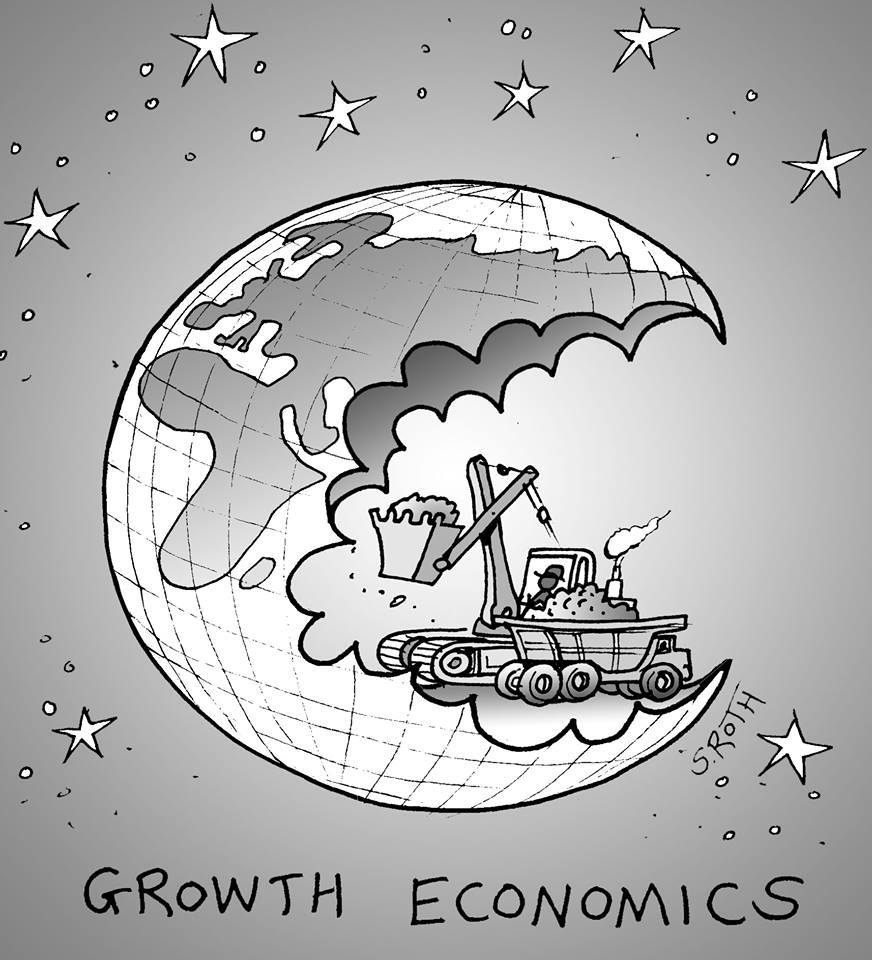
Anyone would think the economy is paramount in our society. Just listen to most politicians. Were they were elected to office by the economy? One would think so, as they do everything for the economy--it's their master and they its servants.

It is time we saw the economy for what it really is, and treat it accordingly.

I like to use a metaphor of the human body when explaining how the economy should work:
  1. The role of the economic system in society should be much like the role of the cardio-vascular system in our body—i.e. vitally important to the health of the whole organism.
  2. However, just as humans don’t exist to serve their cardio-vascular system, nor should society exist to serve the economic system—i.e. “we live in a society, not an economy”.
  3. And, just as individuals strive to have a healthy body (which includes having a healthy cardio-vascular system) so they can do what they want in life, so too should society look at their economic system as a means to enable it to do what it wants.
  4. It’s what we do or accomplish as an individual or a society that matters—no one is remembered for having a healthy-cardio vascular system! They are remembered for what they contributed to society. Thus vision, values and mission are paramount—having healthy internal systems merely enables these to be realised more easily.
As described in the following video, we need to restructure the economy to be non-numeric-growth. The key concept is to create an economy which enables “prosperity without growth”.


If we continue to have our economy dependant on continual growth then, "For how long will we have a planet which can sustain life?"


Monday, 6 December 2010

Increase fitness, build muscle bulk, lose weight, look younger and become smarter to boot!

How: For 20 minutes repeat the following on an exercise bike:
  • sprint for 8 seconds
  • cycle relaxed for 12 seconds
This 20 minute routine must be performed at least five days a week.
Source: Research from the Garvan Institute and the University of New south Wales.

Why this works: Chemical compounds called catecholamines drive weight loss. Catecholamines are produced during sprints.


Alternative

If you'd prefer to get out and about (not use exercise equipment) then Professor Ratey recommends interval training – really pushing yourself hard for between 20 and 30 seconds while running, cycling or swimming, so that you are momentarily exhausted.

Do, say, two minutes of walking, 30 seconds' sprinting, then two minutes of walking again. It doesn't have to be a lot for a long time, but you will really notice the difference. "The side effects on the body aren't bad either - I lost 10 pounds in no time," Professor Ratey says.


  • A bonus! One of the articles on which this post was based says there's evidence that regular physical exercise makes you smarter. More...
  • New research from Tel Aviv University has found that "endurance exercises," like jogging, can make us look younger. The key, exercise, unlocks the stem cells of our muscles: http://bit.ly/dJ6ZfK
  • Lacking motivation, if you are over 30 I suggest you join your local Masters Athletics Club--this is our local club http://bit.ly/fFL4ee --there are clubs like this around the world--their motto is, "If you are old enough, you are good enough."

Monday, 22 November 2010

It doesn't matter what values we have...


However, what does matter, is how we live them. As any beginning student of ethics is told, "even thieves have values."


I am frequently asked, "What are the differences between values, ethics, morals and principles?" My short answer to the question is usually, "Values motivate, morals and ethics constrain." In other words values describe what is important in a person's life, while ethics and morals prescribe what is or is not considered appropriate behaviour in living one's life. Principles inform our choice of values, morals and ethics. "Generally speaking, value refers to the relative worth of a quality or object. Value is what makes something desirable or undesirable" (Shockley-Zalabak 1999, p. 425). Through applying our personal values (usually unconsciously) as benchmarks, we continually make subjective judgments about a whole manner of things:
...we are more likely to make choices that support our value systems than choices that will not. Let us say that financial security is a strong value for an individual. When faced with a choice of jobs, chances are the individual will carefully examine each organisation for potential financial and job security. The job applicant who values financial security may well take a lower salary offer with a well established company over a higher-paying offer from a new, high risk venture. Another job seeker with different values, possibly adventure and excitement, might choose the newer company simply for the potential risk and uncertain future.
Values, therefore, become part of complex attitude sets that influence our behaviour and the behaviour of all those with whom we interact. What we value guides not only our personal choices but also our perceptions of the worth of others. We are more likely, for example, to evaluate highly someone who holds the same hard-work value we do than someone who finds work distasteful, with personal gratification a more important value. We may also call the person lazy and worthless, a negative value label. (Shockley-Zalabak 1999, pp. 425-426)
What then of ethics? Ethics are the standards by which behaviours are evaluated for their morality - their rightness or wrongness. Imagine a person who has a strong value of achievement and success. Knowing only that this value is important to them gives us a general expectation of their behaviour, i.e. we would expect them to be goal oriented, gaining the skills necessary to get what they want, etc. However, we cannot know whether they will cheat to get what they want or "do an honest day's work each day". The latter dimension is a matter of ethics and morality.

Take another example, a person has a high priority value or research/knowledge/insight. They have have a career in medical research. In fact, knowing their value priority we would expect them to have a career in some form of research, however, we do not know from their value priority how they are likely to undergo their research. Will the person conduct experiments on animals, or would they abhor such approaches? Again, the latter is a mater of ethical stance and morality. Johannesen (cited Shockley-Zalabak 1999, p. 437) gives further examples which help distinguish between values and ethics:

Concepts such as material success, individualism, efficiency, thrift, freedom, courage, hard work, prudence, competition, patriotism, compromise, and punctuality all are value standards that have varying degrees of potency in contemporary American culture. But we probably would not view them primarily as ethical standards of right and wrong. Ethical judgments focus more precisely on degrees of rightness and wrongness in human behaviour. In condemning someone for being inefficient, conformist, extravagant, lazy, or late, we probably would not also claim they are unethical. However, standards such as honesty, truthfulness, fairness, and humaneness usually are used in making ethical judgments of rightness and wrongness in human behaviour.

Clearly our values influence what we will determine as ethical; "however, values are our measures of importance, where as ethics represent our judgments about right and wrong" (Shockley-Zalabak 1999, p. 438). This close relationship between importance and right and wrong is a powerful influence on our behaviour and how we evaluate the behaviour of others.

Now let's move to another level. How does one go about choosing what ethics are right? In the next section I describe the approach to answering this question I believe best suited to today’s society.

The Principle Centric Approach to Behavioural Choices

'Principle' is defined in Nuttall's Concise Standard Dictionary of the English Language as, "n. the source or origin of anything;...a general truth or law comprehending many subordinate ones;...tenet or doctrine; a settled law or rule of action;... v.t. to impress with any tenet; to establish firmly in the mind". In this Millennium, perhaps more than ever before, I firmly believe that we need to reformulate a set of principles to guide us. There are two main benefits of taking a principle centric approach to guide all human action: (1) knowing a set of principles concerning 'the nature of things' enables us to make informed choices and judgments as we would know, with a high degree of certainty, the likely outcomes of our actions, (2) knowing even a few principles helps us avoid information
overload. On the latter point, Birch (1999, p. 44) says:
One way in which drowning in information is overcome is by the discovery of principles and theories that tie up a lot of information previously untied. Prior to Charles Darwin biology was a mass of unrelated facts about nature. Darwin tied them together in a mere three principles of evolution: random genetic variation, struggle for existence and natural selection. So we do not need to teach every detail that was taught to nineteenth century students. A mere sample is necessary to illustrate the universal principles.
Before you raise your voice in protest, "What do scientific principles have to do with informing what constitutes ethical and moral human behaviour?" Stop for a moment and ponder the what has been institutionalised into Western society all in the name extolling the virtue of progress through unencumbered evolution - i.e. guided by the principles made evident by Charles Darwin. We push for free trade; level playing fields, argue that cloning interferes with natural selection, push for de-regulation so that competition prevails and only the fit organisations should survive, etc., etc.

But what if we've got Darwin wrong? What if the principles instead were: survival of those who cooperate for the greater good, selection guided by a moral sense, etc. We would have a completely different society from that which we have today. Understanding and internalising the principles that comprise 'the nature of things' is perhaps the single most powerful determining factor in the shaping of the society in which we live. It is vital that we maintain a continual dialogue around principles so those we internalise and institutionalise are up-to-date and are our current best shot at the truth.

Below is a four minute video clip where David Suzuki explains how understanding the principles behind exponential growth should impact on our decisions as to how we live on this planet:


When you have 90 minutes to spare, I highly recommend that you watch David Suzuki's full presentation as it includes many more examples of important principles which should inform human behaviour:


References:

Birch, C. 1999, Biology and the Riddle of Life, University of New South Wales press, Sydney.

Loye, D. 2001, 'Rethinking Darwin: A Vision for the 21st Century', Journal of Futures Studies, vol. 6, no. 1, pp. 121-136.

Shockley-Zalabak, P. 1999, Fundamentals of Organisational Communication: Knowledge, Sensitivity, Skills, Values, Longman: New York.

Friday, 5 November 2010

Transformative leadership is a team effort


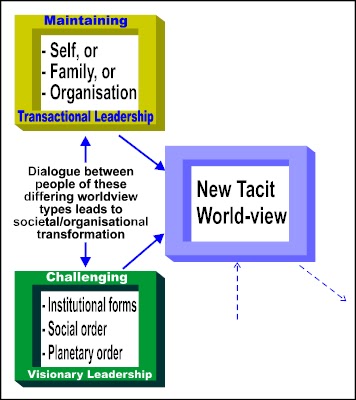
Transformative leadership is a team effort. It requires constructive dialogue between the Transactional leaders (the implementers) and the Visionary leaders (the dreamers).

It's through the dialogue between these two groups that a new tacit worldview emerges.

So who are the Visionary Leaders, and who are the transactional leaders?
     From when we are born our interaction with the world around us stimulates our brain. We quickly begin to develop preferences for some forms of stimulation over others. By late adolescence these preferences are virtually "set in concrete" and we have developed a preference for one of four ways of relating to the world around us: things-abstract, concrete-things, concrete-people, or people-abstract. Below, each of these four ways of dialoguing with reality are briefly described along with preferred leadership modus operandi.


Things-Abstract [Technical Architect]

These are people who have a preference for using their hands to "tinker" with or to create things and to use their intellect to develop models or plans. They rely mostly on discovering things about the world through thinking about it and intellectually analysing it. They prefer to gather information visually.  They are the "accidental leaders" because they will often create a technology which everyone else wants. People such as Bill Gates and the inventor of Facebook are examples. People with this brain-preference are not particularly interested in politics, they are the "corporatists" and would be quite comfortable living a totally privatized world.
    Those who belong to this brain-preference will be seen as visionary leaders if people like the technology they have created.

Things-Concrete [Quality Producer/Crafts Person]

These are "hands on" people who like certainty and like activities/organisations to be well structured. They prefer things to be down-to-earth rather than abstract and intangible.  People with this preference may be athletes, mechanics, surgeons, gardeners, accountants, farmers, etc. They will prefer a political party which gives them certainty and a sense of security. They will also prefer a party which is conservative in its policies rather than one which comes up with innovative new (never-tried-before) policy.
     These people can be fabulous transactional leaders. Those who are masters of their craft will be sought out to teach others the best way to perform their chosen occupation.

Concrete-People [People Servants]

As with the Quality Producers, People Servants like structure. However, their preference is for spending time with and talking to people, rather than relating to the world of non-human things. They will choose careers as school teachers, actors, ethicists, priests/nuns, public servants, value consultants, etc. They will also prefer a party which is somewhat conservative in its policies, however, they will put people ahead of balancing the budget. So, if their party spends too much money on welfare (i.e. caring for those who can't care for them selves), their party will probably be voted out of office and a party supported by the Quality Producers will be voted back in on the promise of spending cuts to bring the budget back into surplus.
     People Servants are great facilitators, they are key to facilitating the oft difficult dialogue between the Visionary Leaders and the Transactional Leaders. Without this dialogue transformation is not possible. Understanding the worldviews and values of each group is essential to facilitating effective dialogue.

People-Abstract [Social Architects]

The Social Architects, like the People Servants, prefer the world of people to the world of non-human things. Social Architects are comfortable functioning in a world of uncertainty--in fact it's their preference--too much of the "same old, same old" and they get bored. Social Architects like to create models to understand how people behave, they like designing new social systems. They are the "greens", social-ecologists, social-activists, social scientists, social policy planners, etc. in our society.
These people are potential Visionary Leaders in respect of societal and/or organisational change. As with the facilitators, to be effective as a visionary leader they must be able to gain rapport with those the desire to influence. Remember, the key is to change is firstly gaining real rapport with people. And, for genuine rapport to exist, people must really know that you are able to see the world through their eyes and therefore understand what they have the values they have.

Change = Rapport + Information

Thursday, 28 October 2010

Creating an uplifting, energizing culture for business success is child's play

It's all about fields which organise the way we work and the principle of self organising systems. Let's start with fields.
Although we know a great deal about the way fields affect the world as we perceive it, the truth is no one really knows what a field is. The closest we can come to describing what they are is to say that they are spatial structures in the fabric of space itself. (Talbot cited Wheatley 1994, p. 46)

Newton’s world of cause and effect required great effort (forces) to make things happen. Since the emergence of the quantum world, we see that it is possible to accomplish this through manipulating non-material structures – i.e. fields – which are the basic substance of the universe. (Wheatley 1994, p. 48)

One explanation of the way fields work is to consider fish in an ocean. As the water moves in synchronism with the swell, the fish all appear to move together from side to side or up and down as though connected by some invisible connector. We know that it is the water of the ocean, however, fields in space behave the same way, we cannot see them and they (unlike the water of the ocean) have no material substance, however, they link all material objects in space. “Physical reality is not only material. Fields are considered real, but they are not material” (Wheatley 1994 p. 50).

The laws of motion, in field language, are rules for flows in the ‘cosmic ocean’. The rules for transformation are telling us what reactions occur among the components in this ocean (Wilczek & Devine cited Wheatley 1994, p.51).
The Newtonian Science Organisation
The Quantum Science Organisation
“An organisation is a collection of choices looking for problems, issues and feelings looking for decision situations in which they might be aired, solutions looking for issues to which there might be an answer, and decision makers looking for work.“ (Cohen March & Olsen cited Wheatley 1994, p. 54)
Organisational order is generated through fields. These fields are conceptual controls – it is the ideas of a business that are controlling, not some manager with authority. One of the most powerful fields is shared meaning or the unconscious common ground within an organisation.
In the field view of organisations, clarity about values or vision is important, but it’s only half the task. Creating the field through the dissemination of those ideas is essential. The field must reach all corners of the organisation, involve everyone, and be available everywhere…we need to imagine ourselves as broadcasters, tall radio beacons of information, pulsating out messages everywhere…we must fill all the spaces with the messages we care about. If we do that, fields develop – and with them, their wondrous capacity to bring energy into form. (Wheatley 1994, pp. 55-56)

The Steps

Q. So how do you go about creating an uplifting, energizing culture for business success? A. Through a values-based process of conscientization:
  1. Have all in your organisation take an inventory of their values. Use the cultural field map referenced below to get a picture of the fields currently creating your organisation's culture.  
  2. Build a common language of values within your organisation.
  3. The magic of self-organising systems will do the rest. (Use the cultural field map after some 18 months to see the change from a fields' perspective).
Well, perhaps it's not child's play, but watching children at play helps with understanding how the principle of self-organising systems creates a great culture once you've put a common language of values in place within your organisation...


More... contact your nearest Values Consultant at: http://bit.ly/dymzCJ

Reference List

For details on Cultural Field Mapping, and other values technologies see: http://bit.ly/bwpThH 
Wheatley, M 1994, Leadership and the New Science: Learning about organization from an orderly universe, Berrett-Koehler, San Francisco.
Tosey, P. & Smith, P. 1999, ‘Assessing the learning organization: part 2 – exploring practical assessment processes’, The Learning Organization: An International Journal, Vol 6, No 3, pp.107-115.

Friday, 15 October 2010

Empathy & the Future of the Human Brain

Recently I published an eZine with an RSA Animate which illustrated how important the value of empathy was to the development of a more peaceful society: http://bit.ly/dbLV3u

I observed that up until September 11 empathy was increasing as a priority in society: http://bit.ly/c1OL37, then it started decreasing.

I postulated that the reason for the reduction in the priority on this value since September 11 was the profound global worldview shift we observed at this watershed in civilisation's history. Within a few days of writing the eZine I saw a presentation from the renowned neuroscientist, Baroness Susan Greenfield, http://bit.ly/bETI1b, on the future of the brain. Susan gives another explanation, due to the impact of modern technology, for the decline in the importance of empathy.

Most likely both of these factors are causing the decrease in the priority on empathy. What do you think?     

Wednesday, 18 August 2010

Dealing with rapid change--Separate Form from Function

I've been programming since 1966. As change accelerated and programmers had to maintain existing software to deal with rapid organisational change, separating form and function became standard practice for all developers. The concept is spelt out beautifully by Ben Hunt:
There is a natural trade-off between functional and aesthetic richness.

You can't have something that is at the same time both an excellent high-functionality application and a great work of online art.

That point falls outside the sphere of design. The reason for this is that things that have the highest aesthetic beauty and impact cause you to stop and look at them, while things that are most functionally effective help you to do the job you want to achieve without being looked at. The two can't happen at the same time.

The most functional web sites are those that are information-rich, quick to load and totally obvious to use. While they can also be pleasing and attractive, their focus on function would be compromised if they were extremely visually impacting.

Likewise, the most beautiful designs - the ones that make you stop and stare - are rich in visually-stimulating elements. While they can certainly also be highly usable, they cannot also feature the weight of highly functional features that would also put them at the very top of the functional quality scale. [Ben Hunt, The Web Doctor]

Read more...

Tuesday, 11 May 2010

Live to be 100+

A recent study found that people who live to be 100+ whilst staying happy and healthy have the following in common:

  • They still live in their own place looking after themselves
  • They have contact with a family member (or equiv) at least once a week
  • They take part in social get-togethers two or three times a week
  • They stay physically active engaging in regular physical exercise doing something they love--e.g. gardening, athletics...
  • They don't smoke
  • Some don't mind alcohol but in moderation
  • They don't internalize negative emotions choosing to have a positive outlook on life 
More...

Friday, 16 April 2010

Boost Your Immune System


It has now been discovered that eating fibre can boost  your immune system.  Below is a brief extract from the ABC's Catalyst program which explains how:
"Kendle Maslowski
"Once insoluble fibre reaches the large intestines, the bacteria in the gut there use it as a food source and they ferment it, and this produces by-products called short chain fatty acids.

"NARRATION
"These short chain fatty acids bind to a receptor on immune cells. This binding instructs immune cells to dampen down inflammation.

"Kendle Maslowski
"This research is new and exciting because for the first time we've shown a direct link between fibre, bacteria in our gut and control of our immune system.

"Professor Charles MacKay
"The connection between diet and the immune system was somewhat of a fringe topic in immunology. Now we have this molecular link because a breakdown of fibre, so-called short chain fatty acids actually directly stimulate our immune cells and relate to arthritis, asthma, inflammatory bowel disease and other things."


Thursday, 11 March 2010

3 Key Principles of Project Management

  1. In experimental or exploratory projects, predictive methods are less likely to be effective than incremental, iterative approaches that present the client with progressive deliverables and then make adjustments and course corrections as the work proceeds.
  2. Teams of self-motivated, skilled practitioners are more likely to succeed and to feel rewarded and productive in self-directed teams in which individuals take ownership of specific deliverables and then devise their own methods of achieving them.
  3. Constant and close collaboration with the client and sponsors of a development effort is more likely to succeed than projects in which the client participates in a front-loaded requirements process and then disengages until the end product is delivered.

Wednesday, 20 January 2010

Optimal Model for Civilization

Principle: Civilization is best served through facilitating people to maximize their well-being (Why? Because the path of happiness is identical to the path of progress);

Motivation/Productivity/Performance

Principle: To increase people's productivity, one must ensure they can engage in tasks which match their values.

Leadership Preference

Principle: People's brain-preference determines whether they have a passion for being a Visionary or Transactional leader

Systems Have Their Own Values

Principle: Systems (organizations, the economy, cultures... ) have values independent of the people in them. The values of systems are those of the people who created them. As people's values change, it's important to re-work systems to be based on people's current values

Thursday, 6 November 2008

Emerging Order

The Key Affiliates team recently changed the New Order Cluster name to Emerging Order. The change was made because a google search shows the these days New Order is mostly associated with conspiracy theories.

Click the title to this post to view a video which gives a good example of how a new order can be created through providing people the right environment and resources to support their values. The new order emerges through the natural process of self-organisation. It is this mechanism which led us to use the new term: Emerging Order.